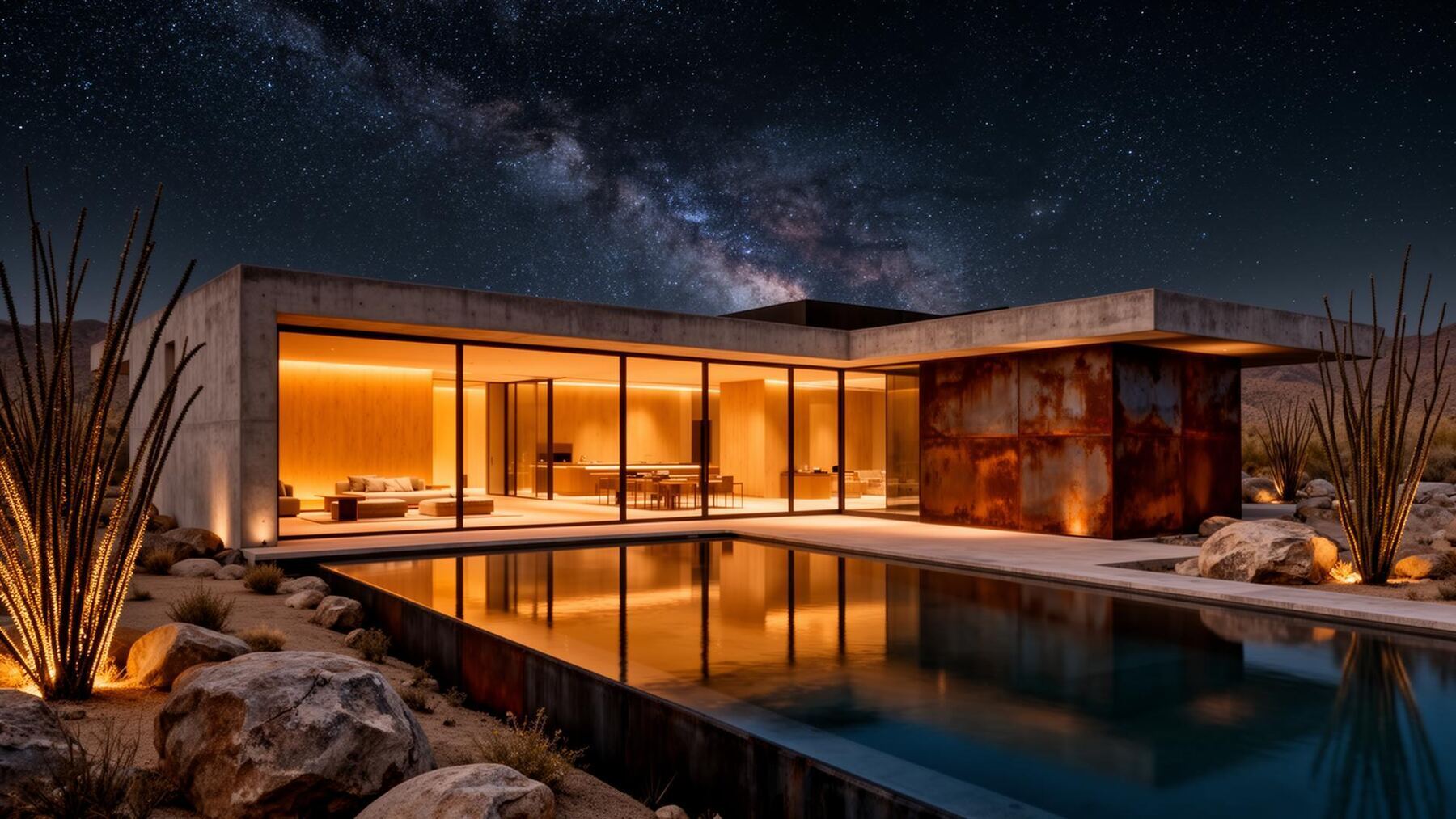
Golden-hour badlands, Milky Way overhead, wildflowers underfoot.
Why photographers love Borrego
You get five distinct subjects in one small area: expansive landscape (badlands), intimate landscape (slot canyons, palm oases), astro (a Bortle 2 sky), macro (wildflowers, ocotillo bloom, cactus detail), and human-made objects at scale (the Galleta Meadows sculptures). Add sculptural weather (fog rolling over the Montezuma Grade, monsoon lightning in July, dust light in spring) and you have a portfolio's worth of subjects within an hour of town.
Sunrise locations
Panoramic Overlook
0.5 mile walk from Borrego Palm Canyon Campground. East-facing over the whole valley. First light hits the mountains behind you and the badlands ahead.
Peg Leg Smith Monument
Roadside, easy dark access, wide open horizon. Coffee at Coyote Steve's after.
Base of Coyote Canyon
The first mile of Coyote Canyon Rd — the road is closed beyond the Third Crossing since Aug 2023, but the accessible lower stretch has backlit ocotillo and low sun on the west face of the Santa Rosas.
Ocotillo Wells dunes
Just east of the park boundary. Long shadows on sand, room to work, essentially no one.
Sunset locations
Font's Point
The classic. 4 miles of dirt to a viewpoint over the badlands with the Salton Sea in the distance. Arrive 45 minutes before sundown, stay for the blue hour.
The Slot rim
Walk the rim above the Slot at last light — deep shadows and warm sandstone.
Galleta Meadows sculptures
45 minutes before sunset for warm rim light and long shadows across the metal. The serpent, the dragon, and the prehistoric horses all photograph beautifully.
S22 pullouts on the Montezuma Grade
Elevated west-facing angle over the whole valley. Best in autumn when the sun sets due west into the gap.
Rooftop of your rental
Underrated. A rooftop deck at a private home gives you a horizon-to-horizon view without a drive back to bed.
Milky Way spots
Anywhere south-facing away from town: Peg Leg Smith Monument, Font's Wash pullouts, or the north edge of the sculpture fields. The sculptures make outstanding Milky Way foreground — the serpent's arches under the galactic core is an iconic composition. See the stargazing guide for timing. Best moon phase: within 5 days of new moon. Best hours: astronomical dark (about 90 minutes after sunset in summer) to about 4 a.m.
Badlands and palm canyons
Badlands: Font's Point at last light, Erosion Road pullouts at first light, the ridges above the Salton Sea for compressed telephoto shots. Palm canyons: mid-day in cool months, when the sun drops into the canyon and lights the palms directly. Palm Canyon and Mountain Palm Springs both work.
Wildflowers and textures
In bloom seasons (Feb–early Apr): Henderson Canyon Rd, Coyote Canyon, DiGiorgio Rd, and any wash off Borrego Springs Rd. For macro: kneel and shoot with a 100mm macro at f/8. For scale, put a photographer in the frame among the flowers. Textures anytime: cracked mud, mesquite bark, ocotillo blossoms, calcite crystals near the mine, sandstone concretions at the Pumpkin Patch.
Drone rules
Drones are prohibited in Anza-Borrego Desert State Park (as in all California state parks). You can fly in nearby BLM areas outside the park boundary and on Ocotillo Wells SVRA land. Always follow FAA rules — under 400 feet AGL, line of sight, avoid people and animals. Never fly over neighborhoods, over the sculptures during peak hours, or near bighorn sheep habitat.
Camera gear — what to bring
Wide zoom (16–35mm f/2.8 or 14–24mm) for astro and landscape. Telephoto (70–200mm f/2.8 or 100–400mm) for compressed badlands shots and wildlife. A macro lens (90–105mm) if you're shooting flowers. Sturdy carbon-fiber tripod (badlands wind can knock a light tripod over). Remote release or intervalometer. Red-light headlamp (Coast HL7R or similar). Extra batteries (cold nights drain fast). Rocket blower and lens cloth — desert dust gets everywhere. A polarizer for daytime landscapes. Bring a mid-range zoom too (24–70mm f/2.8) if you can — the sculptures and town scenes want a standard focal length.
Astrophotography settings and workflow
Basic Milky Way: 14–24mm f/2.8, ISO 3200–6400, 15–25 second exposures. Use the 500 rule (500/focal length = max shutter without star trails). Shoot RAW. For clean results, take 10–20 exposures of the sky, 5 of the foreground with a headlamp painting, and stack in Sequator or Deep Sky Stacker. For deep-sky work: a star tracker (Sky-Watcher Star Adventurer 2i) unlocks 2–4 minute exposures. Foreground pass: light-paint an ocotillo or a sculpture for 1–2 seconds with a warm-white LED at low power. Composition: put the galactic core off-center; use rule of thirds.
Editing tips
Shoot RAW always. For Milky Way, stack for noise reduction. Keep the sky sky-colored — don't over-saturate blue or add fake purple. Warm the foreground slightly to sell the desert light. Lightroom's masking tools are excellent for isolating sky from land. For badlands, push clarity moderately, dehaze cautiously, and pull highlights to recover cloud detail. Never composite Milky Way from one location onto foreground from another and call it real — call it composite if you do.
Best seasons and a sample photo itinerary
November through March: crisp air, low sun angle, dramatic light. Late June through August: Milky Way core high overhead. Sample two-day itinerary: Day 1 — sunset at Font's Point → astro session same night at Galleta Meadows → sunrise at Panoramic Overlook. Day 2 — mid-day in Mountain Palm Springs canyon → drive up the Montezuma Grade for golden hour → dinner at Coyote Steakhouse → second astro session on your rooftop deck.
Frequently asked questions
Can I fly a drone?
Not in the state park (which is most of the area). Yes in Ocotillo Wells SVRA and BLM areas — always check current rules.
What's the single best photo spot?
Font's Point at sunset. It's a cliché because it's true. The 30 minutes after the sun sets are better than the 30 before.
Do I need a full-frame camera?
For deep astro yes; for everything else no. A crop-sensor mirrorless with a fast wide lens will get you 90% of the way.
How do I avoid other photographers at Font's Point?
Weekday sunset, or wait until 15 minutes after sunset when most people leave. The best light is often after they're gone.
Any local photo workshops?
The Anza-Borrego Foundation and a few independent operators run seasonal workshops. Check the ABF calendar.
Stay the night
Moonlight Oasis is a 3-bedroom dark-sky residence in Borrego Springs. Sleeps 13.
Check availability →Keep reading
The Ultimate Guide to Borrego Springs Restaurants & Food
A no-stoplight town with a surprisingly good food scene.
The Ultimate Hiking Guide to Borrego Springs
Palm oases, slot canyons, badlands, and 500+ miles of trail in one state park.
The Complete Stargazing Guide to Borrego Springs
Borrego Springs is one of only two International Dark Sky Communities in California.
The Ultimate Off-Roading Guide to Borrego Springs
Anza-Borrego is one of the most open off-road parks in California.