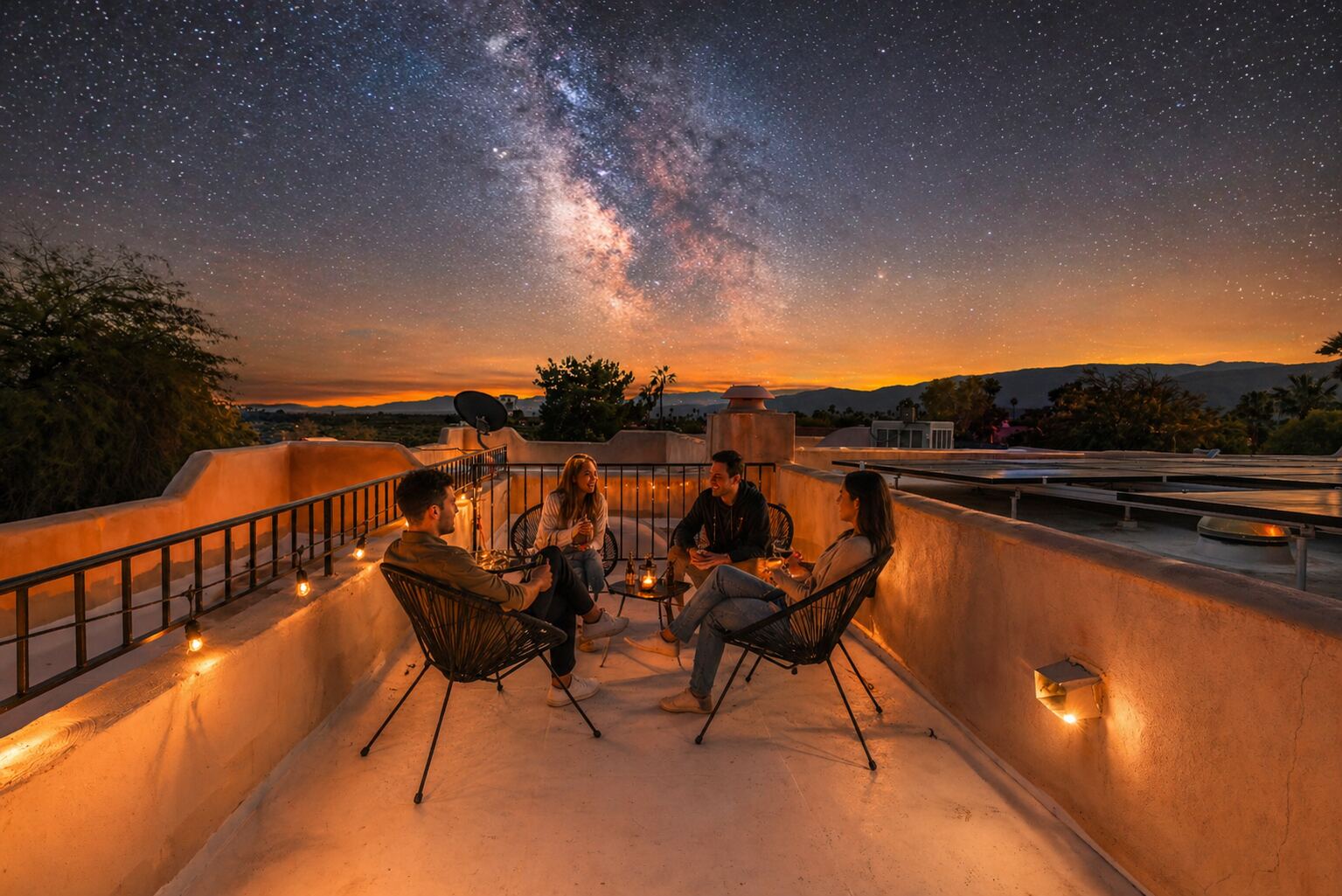
Borrego Springs is one of only two International Dark Sky Communities in California.
Why the sky here is so dark
Three things combine. First: the town's dark-sky ordinance. Every outdoor light is shielded, warm-toned (max 3,000 K), and pointed down — no billboards, no un-shielded floodlights, no gas-station glare. Second: geography. A ring of mountains — the Santa Rosas to the north, the Vallecitos to the south, and the Peninsular Range to the west — blocks the light domes of San Diego, Palm Springs, Indio, and El Centro. Third: the desert air. Low humidity, low dust, no marine layer. On a moonless clear night the naked-eye limiting magnitude here is about 6.8 — enough to see the structure of the summer Milky Way, the Andromeda Galaxy, the Beehive Cluster, the zodiacal light, and airglow on the horizon. This is a Bortle 2 sky, one step from the darkest official rating.
Moon phases and viewing windows
For deep-sky and Milky Way viewing, plan your trip within a week of the new moon. Check timeanddate.com or a lunar phase app — you want the moon below the horizon for at least three or four hours after sunset. A first-quarter moon that sets by 11 p.m. still leaves half the night dark. A full moon washes out the Milky Way entirely but is stunning in its own right — the desert glows silver and you can walk trails without a headlamp. Some people specifically plan trips around a full moon for the moonlit desert; others plan around new moons for astro. Both are worth doing at least once.
Best months by what you'll see
June through August
Peak Milky Way core season. The galactic center rises out of the southern horizon after sunset and climbs straight up. Nights are shortest but the sky is spectacular. Warm nights mean short sleeves and no jacket at midnight.
November through December
Longest nights of the year. The Geminid meteor shower peaks around December 13 — the most reliable shower here, often 100+ meteors per hour. Cool clear air, minimal humidity, superb transparency.
January through March
The winter Milky Way arcs overhead — less dense than the summer core but rich with Orion, the Pleiades, the Beehive, and the Andromeda Galaxy. Add wildflower blooms in February and March and it's the peak all-around season.
October and April
Shoulder Milky Way — the core is either just rising before dawn (October) or setting after sunset (April). Great transparency. Fewer visitors than peak wildflower months.
May and September
Warm nights, less crowded. Milky Way arm is high. Weekday visits get you the whole valley to yourself.
Meteor showers to plan around
Quadrantids — Jan 3–4
Short peak, up to 100/hr in a dark year. Worth a late night if you're already in town.
Lyrids — Apr 22
Modest shower (~20/hr) with occasional fireballs.
Eta Aquariids — May 6
Best just before dawn. Halley's Comet debris.
Perseids — Aug 12
The famous one. Warm nights, 60–80/hr in a dark year. Book far ahead.
Orionids — Oct 21
Steady ~20/hr, another Halley shower.
Leonids — Nov 17
Modest most years, occasional storms.
Geminids — Dec 13–14
The best shower of the year in Borrego — often 100+/hr in a dark sky. Cold night, so pack layers.
Best viewing locations
Anywhere outside town
Once you're a mile from Christmas Circle in any direction, the sky is fully dark. Borrego Springs Rd, Henderson Canyon Rd, and DiGiorgio Rd all deliver.
Font's Point
The most famous viewpoint. Requires a high-clearance vehicle for the 4-mile dirt road in. Full 360° horizon; the Salton Sea shimmers in the distance.
Galleta Meadows sculpture fields
Ricardo Breceda's metal sculptures — dragons, dinosaurs, a 350-foot serpent — under the Milky Way is iconic. Free, on public roads north and south of town.
Culp Valley Campground
Up on the Montezuma Grade at 3,400 feet. Clearer horizon and a totally different framing — you're looking down over the valley.
Peg Leg Smith Monument
10 minutes from town on Henderson Canyon Rd. Open pullout, big sky, easy to find in the dark.
A private backyard or rooftop
The single best experience is a dark backyard or rooftop deck at a rental. No headlights, no other voices, no drive back to bed. Moonlight Oasis's rooftop deck was built specifically for this.
What to actually look for — a beginner's tour
Start with the naked-eye showpieces. Locate the Milky Way band running north–south in summer or east–west in winter. Find the Big Dipper and use the two end stars to point at Polaris — the North Star, dead north, always at the same altitude as your latitude (33° here). From Polaris trace back to Cassiopeia (the W). In autumn, find the Great Square of Pegasus and follow it to a small fuzzy patch — that's the Andromeda Galaxy, 2.5 million light-years away and the farthest thing you can see with your naked eye. In summer, find the Summer Triangle (Vega, Deneb, Altair) and slice the Milky Way in half. Look southwest an hour after sunset in spring for the zodiacal light — a faint pyramid of sunlight scattered off interplanetary dust.
Gear — naked eye, binoculars, telescopes
You don't need a telescope. A pair of 10×50 binoculars is the single best sub-$200 upgrade you can make — the Andromeda Galaxy fills the view, the Orion Nebula becomes a real object, the Beehive Cluster explodes into stars. Recommended: Celestron SkyMaster 8×56 or Nikon Aculon A211 10×50. For a first telescope, a 6- or 8-inch Dobsonian (Zhumell Z8, Orion XT8, Apertura AD8) is unbeatable value at $400–600 — Saturn's rings, Jupiter's moons, dozens of Messier objects. Skip the department-store telescopes with 600× magnification claims; they're worse than binoculars. Bring a red-light headlamp (Coast, Petzl, or Black Diamond) to preserve dark adaptation.
Astrophotography tips
A modern mirrorless camera on a tripod, a 14–24mm f/2.8 lens, ISO 3200–6400, 15–25 second exposures. The 500 rule: max shutter = 500 / focal length before stars trail. A star tracker like the Sky-Watcher Star Adventurer 2i unlocks 2-minute exposures and dramatically cleaner detail on the Milky Way core. Shoot RAW. Take 10–20 exposures and stack in Sequator or Deep Sky Stacker for noise reduction. Shoot 15 minutes after full dark for the darkest sky. Use a red-light headlamp so your eyes stay dark-adapted between frames. Best foreground subjects: an ocotillo silhouette, the sculptures at Galleta Meadows, a palm tree at Borrego Palm Canyon.
Apps and tools
Stellarium (free on desktop, $3 on mobile) is the best planetarium app — set your date, time, and location and see exactly what's up. SkySafari is the pro option. PhotoPills is essential for astrophotography planning — Milky Way position, moon rise/set, sun angles. Clear Outside gives cloud, seeing, and transparency forecasts for astronomers. Heavens-Above tracks the ISS, Starlink trains, and Iridium flares.
Camping under the stars
Dispersed camping is allowed on most of the state park's dirt roads — free, first-come-first-served, and legal. You need a fire pan (no ground fires), water, and a way to pack out waste. The developed campgrounds (Borrego Palm Canyon, Tamarisk Grove) are $25–35/night and have amenities. For serious stargazing, dispersed on Rockhouse Rd or in Blair Valley is unmatched.
Night safety
Coyotes and kit foxes are around at night but not a threat to humans. Watch for rattlesnakes when moving after dark on warm nights — they'll be on warm asphalt or slabs. Always carry a red-light headlamp and let someone know where you're going. A satellite messenger is a good investment if you're going alone or off-trail.
Local events — the Nightfall Star Party
The Anza-Borrego Foundation hosts organized star parties several times a year — free public events with telescopes set up in an open field, expert guides, and a running commentary of what's overhead. Usually October, November, and March. Details on the ABF website. Worth planning around if you're a beginner.
Frequently asked questions
Is the Milky Way really visible without any gear?
Yes — on a moonless night it is bright enough to cast a faint shadow. First-time visitors from cities are often speechless.
When is the best month?
June through August for the Milky Way core; November through February for the longest, calmest nights and the Geminid meteor shower.
Do I need a telescope?
No. 10×50 binoculars will show more than most beginners realize. A telescope is a nice-to-have, not required.
How dark is it, really?
Bortle 2, one step from the darkest official rating. Naked-eye limiting magnitude around 6.8 on a clear moonless night.
What about light from Palm Springs?
The Santa Rosa Mountains block almost all of it. You may see a faint dome on the far northern horizon on a hazy night — that's it.
Can I stargaze in summer without freezing?
Yes — that's summer's advantage. Nights stay 75–85°F. Short sleeves, no jacket, no fingerless gloves.
Stay the night
Moonlight Oasis is a 3-bedroom dark-sky residence in Borrego Springs. Sleeps 13.
Check availability →Keep reading
The Ultimate Guide to Borrego Springs Restaurants & Food
A no-stoplight town with a surprisingly good food scene.
The Ultimate Hiking Guide to Borrego Springs
Palm oases, slot canyons, badlands, and 500+ miles of trail in one state park.
The Ultimate Off-Roading Guide to Borrego Springs
Anza-Borrego is one of the most open off-road parks in California.
Things to Do in Borrego Springs (Complete Guide)
Beyond the stars and the hikes — the full menu.